| .. | ||
| dev | ||
| src | ||
| changelog.txt | ||
| cloc-exclude.txt | ||
| config | ||
| LICENCE | ||
| README.md | ||


Nchan is a scalable, flexible pub/sub server for the modern web, built as a module for the Nginx web server. It can be configured as a standalone server, or as a shim between your application and tens, thousands, or millions of live subscribers. It can buffer messages in memory, on-disk, or via Redis. All connections are handled asynchronously and distributed among any number of worker processes. It can also scale to many nginx server instances with Redis.
Messages are published to channels with HTTP POST requests or websockets, and subscribed also through websockets, long-polling, EventSource (SSE), old-fashioned interval polling, and more. Each subscriber can listen to up to 255 channels per connection, and can be optionally authenticated via a custom application url. An events meta channel is also available for debugging.
For use in a web browser, you can try the NchanSubscriber.js wrapper library. It supports Long-Polling, EventSource, and resumable Websockets -- or you can build your own.
Status and History
The latest Nchan release is v1.0.2 (August 29, 2016) (changelog).
The first iteration of Nchan was written in 2009-2010 as the Nginx HTTP Push Module, and was vastly refactored into its present state in 2014-2016. The present release is in the testing phase. The core features and old functionality are thoroughly tested and stable. Some of the new functionality, especially Redis Cluster may be a bit buggy.
Please help make the entire codebase ready for production use! Report any quirks, bugs, leaks, crashes, or larvae you find.
Upgrade from Nginx HTTP Push Module
Although Nchan is backwards-compatible with all Push Module configuration directives, some of the more unusual and rarely used settings have been disabled and will be ignored (with a warning). See the upgrade page for a detailed list of changes and improvements, as well as a full list of incompatibilities.
Does it scale?
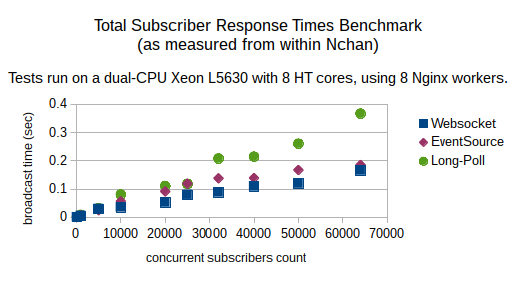
Yes it does. Like Nginx, Nchan can easily handle as much traffic as you can throw at it. I've tried to benchmark it, but my benchmarking tools are much slower than Nchan. The data I've gathered is on how long Nchan itself takes to respond to every subscriber after publishing a message -- this excludes TCP handshake times and internal HTTP request parsing. Basically, it measures how Nchan scales assuming all other components are already tuned for scalability. The graphed data are averages of 5 runs with 50-byte messages.
With a well-tuned OS and network stack on commodity server hardware, expect to handle upwards of 300K concurrent subscribers per second at minimal CPU load. Nchan can also be scaled out to multiple Nginx instances using the Redis storage engine, and that too can be scaled up beyond a single-point-of-failure by using Redis Cluster.
Currently, Nchan's performance is limited by available memory bandwidth. This can be improved significantly in future versions with fewer allocations and the use of contiguous memory pools. Please consider supporting Nchan to speed up the work of memory cache optimization.
Install
Download Packages
- Arch Linux: nginx-nchan and nginx-nchan-git are available in the Arch User Repository.
- Mac OS X: a homebrew package is available.
brew tap homebrew/nginx; brew install nginx-full --with-nchan-module - Debian: nginx-common.deb and nginx-extras.deb. Download both and install them with
dpkg -i, followed bysudo apt-get -f install. These packages should soon be available directly from the Debian repository. - Ubuntu: nginx-common.ubuntu.deb and nginx-extras.ubuntu.deb. Download both and install them with
dpkg -i, followed bysudo apt-get -f install. Who knows when Ubuntu will add them to their repository?... - Fedora: A 64-bit binary rpm and a source rpm are available: nginx-nchan.x86_64.rpm, ngx-nchan.src.rpm.
- A statically compiled binary and associated linux nginx installation files are also available as a tarball.
Build From Source
Grab the latest copy of Nginx from nginx.org. Grab the latest Nchan source from github. Follow the instructions for building Nginx, except during the configure stage, add
./configure --add-module=path/to/nchan ...
If you're using Nginx > 1.9.11, you can build Nchan as a dynamic module with --add-dynamic-module=path/to/nchan
Run make, make install, and enjoy. (Caution, contents may be hot.)
Conceptual Overview
The basic unit of most pub/sub solutions is the messaging channel. Nchan is no different. Publishers send messages to channels with a certain channel id, and subscribers subscribed to those channels receive them. Some number of messages may be buffered for a time in a channel's message buffer before they are deleted. Pretty simple, right?
Well... the trouble is that nginx configuration does not deal with channels, publishers, and subscribers. Rather, it has several sections for incoming requests to match against server and location sections. Nchan configuration directives map servers and locations onto channel publishing and subscribing endpoints:
#very basic nchan config
worker_processes 5;

http {
  server {
    listen       80;

    location = /sub {
      nchan_subscriber;
      nchan_channel_id foobar;
    }

    location = /pub {
      nchan_publisher;
      nchan_channel_id foobar;
    }
  }
}
The above maps requests to the URI /sub onto the channel foobar's subscriber endpoint , and similarly /pub onto channel foobar's publisher endpoint.
Publisher Endpoints
Publisher endpoints are Nginx config locations with the nchan_publisher directive.
Messages can be published to a channel by sending HTTP POST requests with the message contents to the publisher endpoint locations. You can also publish messages through a Websocket connection to the same location.
Publishing Messages
Requests and websocket messages are responded to with information about the channel at time of message publication. Here's an example from publishing with curl:
>  curl --request POST --data "test message" http://127.0.0.1:80/pub

 queued messages: 5
 last requested: 18 sec. ago
 active subscribers: 0
 last message id: 1450755280:0
The response can be in plaintext (as above), JSON, or XML, based on the request's Accept header:
> curl --request POST --data "test message" -H "Accept: text/json" http://127.0.0.2:80/pub

 {"messages": 6, "requested": 55, "subscribers": 0, "last_message_id": "1450755317:0" }
Websocket publishers also receive the same responses when publishing, with the encoding determined by the Accept header present during the handshake.
The response code for an HTTP request is 202 Accepted if no subscribers are present at time of publication, or 201 Created if at least 1 subscriber was present.
Metadata can be added to a message when using an HTTP POST request for publishing. A Content-Type header will be associated as the message's content type (and output to Long-Poll, Interval-Poll, and multipart/mixed subscribers). A X-EventSource-Event header can also be used to associate an EventSource event: line value with a message.
Other Publisher Endpoint Actions
HTTP GET requests return channel information without publishing a message. The response code is 200 if the channel exists, and 404 otherwise:
> curl --request POST --data "test message" http://127.0.0.2:80/pub
  ...

> curl -v --request GET -H "Accept: text/json" http://127.0.0.2:80/pub

 {"messages": 1, "requested": 7, "subscribers": 0, "last_message_id": "1450755421:0" }
HTTP DELETE requests delete a channel and end all subscriber connections. Like the GET requests, this returns a 200 status response with channel info if the channel existed, and a 404 otherwise.
Subscriber Endpoint
Subscriber endpoints are Nginx config locations with the nchan_subscriber directive.
Nchan supports several different kinds of subscribers for receiving messages: Websocket, EventSource (Server Sent Events), Long-Poll, Interval-Poll. HTTP chunked transfer, and HTTP multipart/mixed.
-
Long-Polling
The tried-and-true server-push method supported by every browser out there.
Initiated by sending an HTTPGETrequest to a channel subscriber endpoint.
The long-polling subscriber walks through a channel's message queue via the built-in cache mechanism of HTTP clients, namely with the "Last-Modified" and "Etag" headers. Explicitly, to receive the next message for given a long-poll subscriber response, send a request with the "If-Modified-Since" header set to the previous response's "Last-Modified" header, and "If-None-Match" likewise set to the previous response's "Etag" header.
Sending a request without a "If-Modified-Since" or "If-None-Match" headers returns the oldest message in a channel's message queue, or waits until the next published message, depending on the value of thenchan_subscriber_first_messageconfig directive.
A message's associated content type, if present, will be sent to this subscriber with theContent-Typeheader. -
Interval-Polling
Works just like long-polling, except if the requested message is not yet available, immediately responds with a
304 Not Modified. There is no way to differentiate between long-poll and interval-poll subscriber requests, so long-polling must be disabled for a subscriber location if you wish to use interval-polling. -
Websocket
Bidirectional communication for web browsers. Part of the HTML5 spec. Nchan supports the latest protocol version 13 (RFC 6455).
Initiated by sending a websocket handshake to the desired subscriber endpoint location.
If the websocket connection is closed by the server, thecloseframe will contain the HTTP response code and status line describing the reason for closing the connection. Server-initiated keep-alive pings can be configured with thenchan_websocket_ping_intervalconfig directive. Websocket extensions are not yet supported.
Messages published through a websocket connection can be forwarded to an upstream application with thenchan_publisher_upstream_requestconfig directive.
Websocket subscribers can use the customws+meta.nchansubprotocol to receive message metadata with messages, making websocket connections resumable. Messages received with this subprotocol are of the formid: message_id content-type: message_content_type \n message_data
The
content-type:line may be omitted. -
EventSource
Also known as Server-Sent Events or SSE, it predates Websockets in the HTML5 spec, and is a very simple protocol.
Initiated by sending an HTTPGETrequest to a channel subscriber endpoint with the "Accept: text/event-stream" header.
Each messagedata:segment will be prefaced by the messageid:.
To resume a closed EventSource connection from the last-received message, one should start the connection with the "Last-Event-ID" header set to the last message'sid.
Unfortunately, browsers don't support setting this header for anEventSourceobject, so by default the last message id is set either from the "Last-Event-Id" header or thelast_event_idurl query string argument.
This behavior can be configured via thenchan_subscriber_last_message_idconfig.
A message's associatedeventtype, if present, will be sent to this subscriber with theevent:line. -
HTTP multipart/mixed
The
multipart/mixedMIMEtype was conceived for emails, but hey, why not use it for HTTP? It's easy to parse and includes metadata with each message.
Initiated by including anAccept: multipart/mixedheader.
The response headers and the unused "preamble" portion of the response body are sent right away, with the boundary string generated randomly for each subscriber. Each subsequent message will be sent as one part of the multipart message, and will include the message time and tag (Last-ModifiedandEtag) as well as the optionalContent-Typeheaders.
Each message is terminated with the next multipart message's boundary without a trailing newline. While this conforms to the multipart spec, it is unusual as multipart messages are defined as starting, rather than ending with a boundary.
A message's associated content type, if present, will be sent to this subscriber with theContent-Typeheader. -
HTTP Raw Stream
A simple subscription method similar to the streaming subscriber of the Nginx HTTP Push Stream Module. Messages are appended to the response body, separated by a newline or configurable by
nchan_subscriber_http_raw_stream_separator. -
HTTP Chunked Transfer
This subscription method uses the
chunkedTransfer-Encodingto receive messages.
Initiated by explicitly includingchunkedin theTEheader:
TE: chunked(orTE: chunked;q=??where the qval > 0)
The response headers are sent right away, and each message will be sent as an individual chunk. Note that because a zero-length chunk terminates the transfer, zero-length messages will not be sent to the subscriber.
Unlike the other subscriber types, thechunkedsubscriber cannot be used with http/2 because it dissallows chunked encoding.
PubSub Endpoint
PubSub endpoints are Nginx config locations with the nchan_pubsub directive.
A combination of publisher and subscriber endpoints, this location treats all HTTP GET
requests as subscribers, and all HTTP POST as publishers. One simple use case is an echo server:
  location = /pubsub {
    nchan_pubsub;
    nchan_channel_id foobar;
  }
A more applicable setup may set different publisher and subscriber channel ids:
  location = /pubsub {
    nchan_pubsub;
    nchan_publisher_channel_id foo;
    nchan_subscriber_channel_id bar;
  }
Here, subscribers will listen for messages on channel foo, and publishers will publish messages to channel bar. This can be useful when setting up websocket proxying between web clients and your application.
The Channel ID
So far the examples have used static channel ids, which is not very useful in practice. It can be set to any nginx variable, such as a querystring argument, a header value, or a part of the location url:
  location = /sub_by_ip {
    #channel id is the subscriber's IP address
    nchan_subscriber;
    nchan_channel_id $remote_addr;
  }

  location /sub_by_querystring {
    #channel id is the query string parameter chanid
    # GET /sub/sub_by_querystring?foo=bar&chanid=baz will have the channel id set to 'baz'
    nchan_subscriber;
    nchan_channel_id $arg_chanid;
  }

  location ~ /sub/(\w+)$ {
    #channel id is the word after /sub/
    # GET /sub/foobar_baz will have the channel id set to 'foobar_baz'
    # I hope you know your regular expressions...
    nchan_subscriber;
    nchan_channel_id $1; #first capture of the location match
  }
Channel Multiplexing
Any subscriber location can be an endpoint for up to 255 channels. Messages published to all the specified channels will be delivered in-order to the subscriber. There are two ways to enable multiplexing:
Up to 7 channel ids can be specified for the nchan_channel_id or nchan_channel_subscriber_id config directive:
  location ~ /multisub/(\w+)/(\w+)$ {
    nchan_subscriber;
    nchan_channel_id "$1" "$2" "common_channel";
    #GET /multisub/foo/bar will be subscribed to:
    # channels 'foo', 'bar', and 'common_channel',
    #and will receive messages from all of the above.
  }
For more than 7 channels, nchan_channel_id_split_delimiter can be used to split the nchan_channel_id or nchan_channel_subscriber_id into up to 255 individual channel ids:
  location ~ /multisub-split/(.*)$ {
    nchan_subscriber;
    nchan_channel_id "$1";
    nchan_channel_id_split_delimiter ",";
    #GET /multisub-split/foo,bar,baz,a will be subscribed to:
    # channels 'foo', 'bar', 'baz', and 'a'
    #and will receive messages from all of the above.
  }
DELETE requests on any channel are forwarded to relevant multi-channel subscribers, and their connections are terminated.
Publishing to multiple channels with a single request is also possible, with similar configuration:
  location ~ /multipub/(\w+)/(\w+)$ {
    nchan_publisher;
    nchan_channel_id "$1" "$2" "another_channel";
  }
Storage
Nchan can stores messages in memory, on disk, or via Redis. Memory storage is much faster, whereas Redis has additional overhead as is considerably slower for publishing messages, but offers near unlimited scalability for broadcast use cases with far more subscribers than publishers.
Memory Storage
This storage method uses a segment of shared memory to store messages and channel data. Large messages as determined by Nginx's caching layer are stored on-disk. The size of the memory segment is configured with nchan_max_reserved_memory. Data stored here is not persistent, and is lost if Nginx is restarted or reloaded.
Redis
Nchan can also store messages and channels on a Redis server, or in a Redis cluster. To use a Redis server, set nchan_use_redis on; and set the server url with nchan_redis_url. These two settings are inheritable by nested locations, so it is enough to set them within an http { } block to enable Redis for all Nchan locations in that block. Different locations can also use different Redis servers.
To use a Redis Cluster, the Redis servers acting as cluster nodes need to be configured in an upstream { } block:
  upstream redis_cluster {
    nchan_redis_server redis://127.0.0.1:7000;
    nchan_redis_server redis://127.0.0.1:7001;
    nchan_redis_server redis://127.0.0.1:7002;
  }
It is best to specify all master cluster nodes, but this is not required -- as long as Nchan can connect to at least 1 node, it will discover and connect to the whole cluster.
To use Redis Cluster in an Nchan location, use the nchan_redis_pass setting:
  location ~ /pubsub/(\w+)$ {
    nchan_channel_id $1;
    nchan_pubsub;
    nchan_redis_pass redis_cluster;
  }
Note that nchan_redis_pass implies nchan_use_redis on;, and that this setting is not inherited by nested locations.
When connecting several Nchan servers to the same Redis server (or cluster), the servers must have their times synced up. Failure to do so may result in missing and duplicated messages.
Variables
Nchan makes several variables usabled in the config file:
-
$nchan_channel_id
The channel id extracted from a publisher or subscriber location request. For multiplexed locations, this is the first channel id in the list. -
$nchan_channel_id1,$nchan_channel_id2,$nchan_channel_id3,$nchan_channel_id4
As above, but for the nth channel id in multiplexed channels. -
$nchan_subscriber_type
For subscriber locations, this variable is set to the subscriber type (websocket, longpoll, etc.). -
$nchan_publisher_type
For subscriber locations, this variable is set to the subscriber type (http or websocket). -
$nchan_prev_message_id,$nchan_message_idThe current and previous (if applicable) message id for publisher request or subscriber response. -
$nchan_channel_eventFor channel events, this is the event name. Useful when configuringnchan_channel_event_string.
Additionally, nchan_stub_status data is also exposed as variables. These are available only when nchan_stub_status is enabled on at least one location:
$nchan_stub_status_total_published_messages$nchan_stub_status_stored_messages$nchan_stub_status_shared_memory_used$nchan_stub_status_channels$nchan_stub_status_subscribers$nchan_stub_status_redis_pending_commands$nchan_stub_status_redis_connected_servers$nchan_stub_status_total_ipc_alerts_received$nchan_stub_status_ipc_queued_alerts$nchan_stub_status_total_ipc_send_delay$nchan_stub_status_total_ipc_receive_delay
Configuration Directives
-
nchan_channel_id
arguments: 1 - 7
default:(none)
context: server, location, ifChannel id for a publisher or subscriber location. Can have up to 4 values to subscribe to up to 4 channels.
-
nchan_channel_id_split_delimiter
arguments: 1
default:(none)
context: server, location, ifSplit the channel id into several ids for multiplexing using the delimiter string provided.
-
nchan_eventsource_event
arguments: 1
default:(none)
context: server, location, ifSet the EventSource
event:line to this value. When used in a publisher location, overrides the published message'sX-EventSource-Eventheader and associates the message with the given value. When used in a subscriber location, overrides all messages' associatedevent:string with the given value. -
nchan_longpoll_multipart_response
[ off | on | raw ]
arguments: 1
default:off
context: server, location, ifwhen set to 'on', enable sending multiple messages in a single longpoll response, separated using the multipart/mixed content-type scheme. If there is only one available message in response to a long-poll request, it is sent unmodified. This is useful for high-latency long-polling connections as a way to minimize round-trips to the server. When set to 'raw', sends multiple messages using the http-raw-stream message separator.
-
nchan_publisher
[ http | websocket ]
arguments: 0 - 2
default:http websocket
context: server, location, if
legacy name: push_publisherDefines a server or location as a publisher endpoint. Requests to a publisher location are treated as messages to be sent to subscribers. See the protocol documentation for a detailed description.
-
nchan_publisher_channel_id
arguments: 1 - 7
default:(none)
context: server, location, ifChannel id for publisher location.
-
nchan_publisher_upstream_request
<url>
arguments: 1
context: server, location, ifSend POST request to internal location (which may proxy to an upstream server) with published message in the request body. Useful for bridging websocket publishers with HTTP applications, or for transforming message via upstream application before publishing to a channel.
The upstream response code determine how publishing will proceed. A200 OKwill publish the message from the upstream response's body. A304 Not Modifiedwill publish the message as it was received from the publisher. A204 No Contentwill result in the message not being published. -
nchan_pubsub
[ http | websocket | eventsource | longpoll | intervalpoll | chunked | multipart-mixed | http-raw-stream ]
arguments: 0 - 6
default:http websocket eventsource longpoll chunked multipart-mixed
context: server, location, ifDefines a server or location as a pubsub endpoint. For long-polling, GETs subscribe. and POSTs publish. For Websockets, publishing data on a connection does not yield a channel metadata response. Without additional configuration, this turns a location into an echo server.
-
nchan_subscriber
[ websocket | eventsource | longpoll | intervalpoll | chunked | multipart-mixed | http-raw-stream ]
arguments: 0 - 5
default:websocket eventsource longpoll chunked multipart-mixed
context: server, location, if
legacy name: push_subscriberDefines a server or location as a channel subscriber endpoint. This location represents a subscriber's interface to a channel's message queue. The queue is traversed automatically, starting at the position defined by the
nchan_subscriber_first_messagesetting.
The value is a list of permitted subscriber types. -
nchan_subscriber_channel_id
arguments: 1 - 7
default:(none)
context: server, location, ifChannel id for subscriber location. Can have up to 4 values to subscribe to up to 4 channels.
-
nchan_subscriber_compound_etag_message_id
arguments: 1
default:off
context: server, location, ifOverride the default behavior of using both
Last-ModifiedandEtagheaders for the message id.
Enabling this option packs the entire message id into theEtagheader, and discards
Last-ModifiedandIf-Modified-Sinceheaders. -
nchan_subscriber_first_message
[ oldest | newest | <number> ]
arguments: 1
default:oldest
context: server, location, ifControls the first message received by a new subscriber. 'oldest' starts at the oldest available message in a channel's message queue, 'newest' waits until a message arrives. If a number
nis specified, starts atnth message from the oldest. (-nstart atnth from now). 0 is equivalent to 'newest'. -
nchan_subscriber_http_raw_stream_separator
<string>
arguments: 1
default:\n
context: server, location, ifMessage separator string for the http-raw-stream subscriber. Automatically terminated with a newline character.
-
nchan_subscriber_last_message_id
arguments: 1 - 5
default:$http_last_event_id $arg_last_event_id
context: server, location, ifIf
If-Modified-SinceandIf-None-Matchheaders are absent, set the message id to the first non-empty of these values. Used primarily as a workaround for the inability to set the firstLast-Message-Idof a web browser's EventSource object. -
nchan_subscriber_message_id_custom_etag_header
arguments: 1
default:(none)
context: server, location, ifUse a custom header instead of the Etag header for message ID in subscriber responses. This setting is a hack, useful when behind a caching proxy such as Cloudflare that under some conditions (like using gzip encoding) swallow the Etag header.
-
nchan_subscriber_timeout
<number> (seconds)
arguments: 1
default:0 (none)
context: http, server, location, if
legacy name: push_subscriber_timeoutMaximum time a subscriber may wait for a message before being disconnected. If you don't want a subscriber's connection to timeout, set this to 0. When possible, the subscriber will get a response with a
408 Request Timeoutstatus; otherwise the subscriber will simply be disconnected. -
nchan_websocket_ping_interval
<number> (seconds)
arguments: 1
default:0 (none)
context: server, location, ifInterval for sending websocket ping frames. Disabled by default.
-
nchan_authorize_request
<url>
arguments: 1
context: server, location, ifSend GET request to internal location (which may proxy to an upstream server) for authorization of a publisher or subscriber request. A 200 response authorizes the request, a 403 response forbids it.
-
nchan_max_reserved_memory
<size>
arguments: 1
default:32M
context: http
legacy name: push_max_reserved_memoryThe size of the shared memory chunk this module will use for message queuing and buffering.
-
nchan_message_buffer_length
<number>
arguments: 1
default:10
context: http, server, location
legacy names: push_max_message_buffer_length, push_message_buffer_lengthPublisher configuration setting the maximum number of messages to store per channel. A channel's message buffer will retain a maximum of this many most recent messages.
-
nchan_message_timeout
<time>
arguments: 1
default:1h
context: http, server, location
legacy name: push_message_timeoutPublisher configuration setting the length of time a message may be queued before it is considered expired. If you do not want messages to expire, set this to 0. Applicable only if a nchan_publisher is present in this or a child context.
-
nchan_redis_idle_channel_cache_timeout
<time>
arguments: 1
default:30s
context: http, server, locationA Redis-stored channel and its messages are removed from memory (local cache) after this timeout, provided there are no local subscribers.
-
nchan_redis_pass
arguments: 1
context: http, server, locationUse an upstream config block for Redis servers.
-
nchan_redis_ping_interval
arguments: 1
default:4m
context: http, server, locationSend a keepalive command to redis to keep the Nchan redis clients from disconnecting. Set to 0 to disable.
-
nchan_redis_server
arguments: 1
context: upstreamUsed in upstream { } blocks to set redis servers.
-
nchan_redis_url
arguments: 1
default:127.0.0.1:6379
context: http, server, locationThe path to a redis server, of the form 'redis://:password@hostname:6379/0'. Shorthand of the form 'host:port' or just 'host' is also accepted.
-
nchan_store_messages
[ on | off ]
arguments: 1
default:on
context: http, server, location, if
legacy name: push_store_messagesPublisher configuration. "
off" is equivalent to settingnchan_message_buffer_length 0, which disables the buffering of old messages. Using this setting is not recommended when publishing very quickly, as it may result in missed messages. -
nchan_use_redis
[ on | off ]
arguments: 1
default:off
context: http, server, locationUse redis for message storage at this location.
-
nchan_access_control_allow_origin
<string>
arguments: 1
default:*
context: http, server, locationSet the Cross-Origin Resource Sharing (CORS)
Access-Control-Allow-Originheader to this value. If the publisher or subscriber request'sOriginheader does not match this value, respond with a403 Forbidden. -
nchan_channel_group
<string>
arguments: 1
default:(none)
context: server, location, if
legacy name: push_channel_groupBecause settings are bound to locations and not individual channels, it is useful to be able to have channels that can be reached only from some locations and never others. That's where this setting comes in. Think of it as a prefix string for the channel id.
-
nchan_subscribe_existing_channels_only
[ on | off ]
arguments: 1
default:off
context: http, server, location
legacy name: push_authorized_channels_onlyWhether or not a subscriber may create a channel by sending a request to a subscriber location. If set to on, a publisher must send a POST or PUT request before a subscriber can request messages on the channel. Otherwise, all subscriber requests to nonexistent channels will get a 403 Forbidden response.
-
nchan_channel_event_string
<string>
arguments: 1
default:$nchan_channel_event $nchan_channel_id
context: server, location, ifContents of channel event message
-
nchan_channel_events_channel_id
arguments: 1
context: server, location, ifChannel id where
nchan_channel_id's events should be sent. Events like subscriber enqueue/dequeue, publishing messages, etc. Useful for application debugging. The channel event message is configurable via nchan_channel_event_string. The channel group for events is hardcoded to 'meta'. -
nchan_stub_status
arguments: 0
context: locationSimilar to Nginx's stub_status directive, requests to an
nchan_stub_statuslocation get a response with some vital Nchan statistics. This data does not account for information from other Nchan instances, and monitors only local connections, published messages, etc. -
nchan_max_channel_id_length
<number>
arguments: 1
default:512
context: http, server, location
legacy name: push_max_channel_id_lengthMaximum permissible channel id length (number of characters). Longer ids will be truncated.
-
nchan_max_channel_subscribers
<number>
arguments: 1
default:0 (unlimited)
context: http, server, location
legacy name: push_max_channel_subscribersMaximum concurrent subscribers.
-
nchan_channel_timeout
arguments: 1
context: http, server, location
legacy name: push_channel_timeoutAmount of time an empty channel hangs around. Don't mess with this setting unless you know what you are doing!
-
nchan_storage_engine
[ memory | redis ]
arguments: 1
default:memory
context: http, server, locationDevelopment directive to completely replace default storage engine. Don't use unless you are an Nchan developer.
Contribute
Please support this project with a donation to keep me warm through the winter. I accept bitcoin at 15dLBzRS4HLRwCCVjx4emYkxXcyAPmGxM3 . Other donation methods can be found at https://nchan.slact.net